News
State bill threatens NC wetlands, waters
Environmental, Neuse River Watershed, Sound Rivers, Tar-Pamlico Watershed, Water Quality, Wetlands
Posted on April 17th, 2025
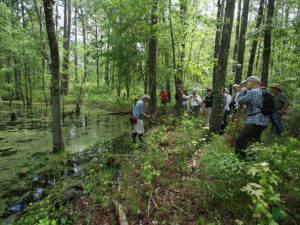
A vernal pool near the Neuse River Greenway.
A bill recently proposed in the North Carolina Senate could further erode protections for North Carolina streams, wetlands, lakes and riparian buffers.
Senate Bill 472 proposes any 401-permit application — a process overseen by the state — that has received a Nationwide Permit from the U.S. Army Corps of Engineers would be automatically approved if the application isn’t processed by the North Carolina Department of Environmental Quality within five days.
Construction of pipelines and mining operations are among projects that could fall into this five-day window for review.
By setting up such a narrow timeline, the bill will, in effect, give all authority to the Corps for 401 certification review, according to Sound Rivers Executive Director Heather Deck.
“An underfunded and understaffed DEQ combined with unrealistic timelines will gut state review,” Heather said. “Essentially, we’re handing over decisions on impacts to North Carolina wetlands and waterways to the federal Corps of Engineers. This will have impacts on future flooding, stream health, likely fisheries habitat and more.”
State 401 certification is required for any federally permitted or licensed activity that may result in a discharge to waters of the U.S. and makes sure a given project will not degrade Waters of the State or violate North Carolina water-quality standards, according to the DEQ website. Any project that disturbs a wetland requires a 401 certification, which can allow for more stringent protections of North Carolina’s environment and resources than Army Corps of Engineers’ process. The state review is a more thorough review of the impact of filling wetlands or impacting streams.
“The Corps is not required to look at the impacts to water quality, so the state review is critical,” Heather said.
The Army Corps of Engineers follows federal rules, which includes a narrowed definition of what’s considered a wetland — a definition established by the 2023 Sackett v. EPA U.S. Supreme Court ruling. The North Carolina General Assembly adopted the same, voting to define N.C.’s wetlands as they’re defined at the federal level. The result was the loss of protections for over a million acres of North Carolina wetlands.
Senate Bill 472 potentially puts them further at risk.
“First, it’s the Supreme Court ruling, then the state lessens regulations to match, then this,” Heather said. “It’s ‘death by a thousand cuts.’ It’s a bad bill and it sets a bad precedent. I would encourage our readers to contact their state senator and ask them to oppose this bill– we need clean water for drinking, recreation and supporting our state’s billion-dollar fishing industry”
Want to know why wetlands are worth protecting? Let Neuse Riverkeeper Samantha Krop and wetlands expert David Lekson tell you in Sound Rivers newest podcast episode “What About Wetlands?” Listen to it here or search for the podcast “Sound Rivers: Riverkeeping Tales from the Neuse & Tar-Pamlico” on Apple Podcasts, Spotify or Amazon Music using keyword “riverkeeping.”
Think wetlands should be protected? So do we! Donate today to fight for North Carolina’s wetlands!
Related News

OYSTER ROAST 2026: Everything you need to know!
September 2nd 2026
Vote!
October 15th 2026
Industrial park threatens nearly 30 acres of wetlands
October 15th 2026
Riverkeeper gives recap of Neuse fish kill
October 15th 2026
NC Land and Water Fund comes through with two new grants
October 15th 2026
Staff, Cummins volunteers return for rain garden rehab
October 15th 2026
Photo of the Week: Sampling Run
October 15th 2026
Pamlico-Tar Riverkeeper visit Cypress Landing
October 15th 2026
CONSTRUCTION ALERT: A head’s up for Neuse paddlers in Wake County
October 15th 2026