News
Specialist investigates lake connection to mysterious skin rash
Algal Blooms, Environmental, Neuse River Watershed, Sound Rivers, Water Quality
Posted on July 10th, 2025
A water sample collected from Cypress Lake has a slight greenish tinge, an algal bloom indicator.
Water Quality Specialist Taylor Register was on the move this week, seeking the potential cause of a “pretty gnarly” skin rash.
“About a week or so ago, we received a hotline call from the Cypress Lake area of New Bern along the Trent River,” Taylor said. “Residents in that community were concerned about the water quality of the lake due to the brownish color of the water, which, at first glance to us, looked like your usual tannic water that you see around here. However, this lake is a popular swimming spot for residents, and we received a follow-up report of the skin rash, which happened after someone swam in the lake with a cut on their foot.”
At this point, Taylor said, she knew something was going on in the water.
On Wednesday, she paid a visit to the lake, courtesy of the property owner who called in the issue. Taylor said everything looked normal, but she collected some water samples to test for E. coli, in case the source of skin irritation was bacterial. But it was when she put her YSI meter in to collect some other data that the situation became a little less murky.
“When I threw in the YSI to get some readings, the dissolved oxygen levels and pH immediately jumped up, which is a pretty solid red flag for an algal bloom,” Taylor said. “I started to take a closer look at the water, and, sure enough, there was just the slightest green tinge in the sunlight.”

E. coli can cause skin infections, and certain species of harmful algal blooms can, as well.
“That’s part of the reason why we tell everybody to stay out of the water when you suspect an algal bloom might be present,” Taylor said.
Taylor has reported the issue to the North Carolina Department of Environmental Quality’s Fish Kill and Algal Bloom Response Dashboard.
“Hopefully, they have the staff capacity to collect some samples, and let us know if any species of cyanobacteria are present, or if this is a relatively harmless bloom,” Taylor said.
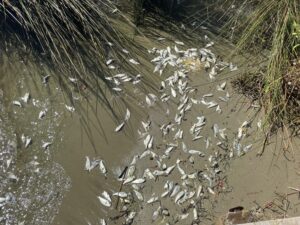
She said the extremely hot and dry weather that eastern North Carolina has experienced lately has led to elevated algal activity in the lower Neuse. Two separate fish kills have been reported to Sound Rivers in July, one of which resulted in thousands of dead juvenile menhaden washing up on Flanners Beach at the Neuse River Recreation Area in Croatan National Forest.
“This instance in Cypress Lake definitely won’t be the last call we respond to in the coming weeks,” Taylor said.
Like the work your Riverkeeping team is doing? So do we! Donate today to support Taylor’s investigations!
Related News

OYSTER ROAST 2026: Everything you need to know!
September 2nd 2026

Vote!
October 15th 2026
Industrial park threatens nearly 30 acres of wetlands
October 15th 2026
Riverkeeper gives recap of Neuse fish kill
October 15th 2026
NC Land and Water Fund comes through with two new grants
October 15th 2026
Staff, Cummins volunteers return for rain garden rehab
October 15th 2026
Photo of the Week: Sampling Run
October 15th 2026
Pamlico-Tar Riverkeeper visit Cypress Landing
October 15th 2026
CONSTRUCTION ALERT: A head’s up for Neuse paddlers in Wake County
October 15th 2026