
News
Sound Rivers breaks ground on innovative stormwater solution
Education, Environmental, Neuse River Watershed, Sound Rivers, Stormwater Restoration Projects, Water Quality
Posted on November 20th, 2025
An innovative stormwater infrastructure project is underway in Craven County, thanks to Sound Rivers and a North Carolina Land and Water Fund grant.
Sound Rivers Program Director Clay Barber was on hand last week when partners Kris Bass Engineering and Backwater Environmental broke ground on an unusual regenerative stormwater conveyance system at West Craven Middle School — part of Sound Rivers’ Campus Stormwater Program.
“This project is unusual in that the area where we’re working is not as steep or as drastic an erosion project that we normally deal with. This is more a preventative measure moment,” Clay said. “We’re constructing it to prevent future harm and to study the effectiveness of the design — the idea being that if this is successful, there won’t be any more problems here and we’ll have clean water, but if it’s not successful, there would be more erosion, trees would likely come down, sinkholes would form, etc., which is what was going to happen without it anyway.”

Regenerative stormwater conveyance systems typically funnel stormwater into a series of pools down a slope, causing the water to slow down and be absorbed rather than eroding the slope itself. The WCMS project is different in that there is little slope, and stormwater from the school’s athletic fields flows arbitrarily through a small wooded area, causing random erosion. This RSC is adding height to the landscape in the form of berms to funnel stormwater into an RSC though the woods.
“We are altering the environment with natural materials to clean the water that flows through here and slow it down and spread it out and encourage it to sink down into the ground before it hits the Neuse River,” Clay said. “This is a wooded area beside the field; it’s called an ephemeral channel within a riparian corridor, which is fancy speak for where the water runs through the trees.”
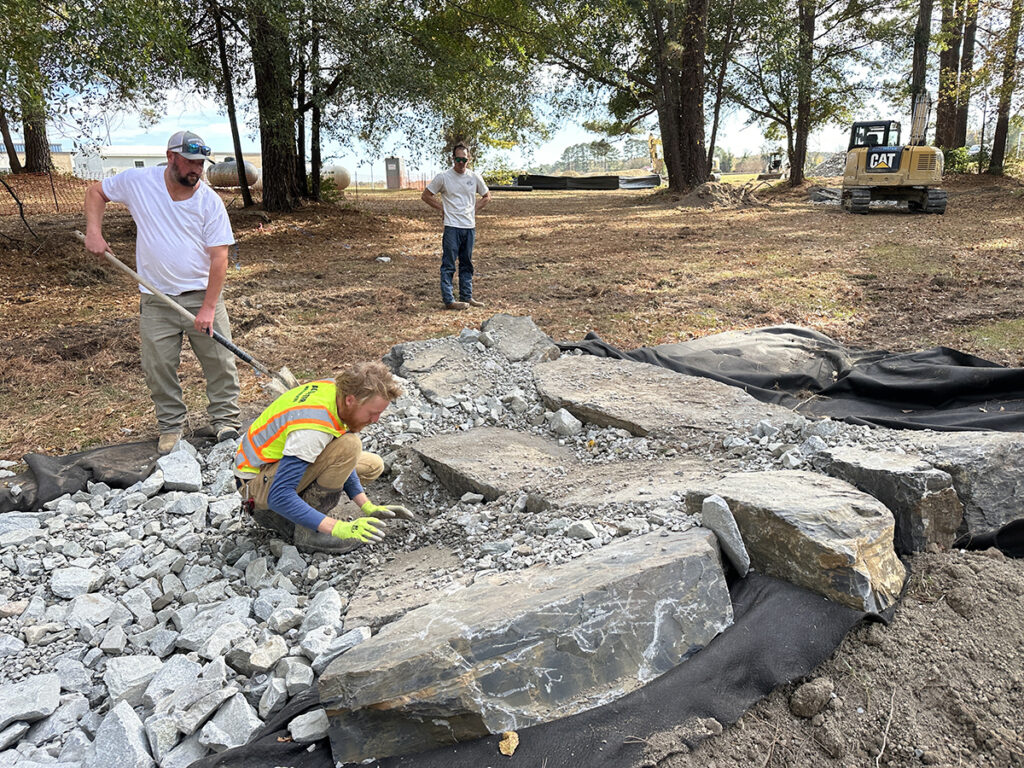
Where previous green stormwater infrastructure projects Sound Rivers has worked on involves digging out earth to effectively store stormwater, this one adds earth—and a unique blend, at that.
“Those berms that are sticking out to the side — it’s a special mixture of rock and sandy minerals, and they mix stuff in there to support plants,” Clay said. “In light rains and normal rains, they’re kind of like funnels to get the water to the center channel and the rocks and pools. In heavy rains, the water will push through it. So, it’s firm enough to hold plants and porous enough to let water go through it.”
Sound Rivers has partnered with Dr. Charlie Humphrey of East Carolina University’s Health and Human Services, to study the efficacy of this innovative project. Prior to the construction start last week, Humphrey’s team collected erosion data in the target area, and will continue to collect data for comparison in the months after the project is completed.
Like Sound Rivers’ Campus Stormwater Program? We certainly do! Donate today to support innovation in our green stormwater infrastructure projects at public schools across the Neuse and Tar-Pamlico watersheds!

Related News
Walnut Creek trash trap install ‘a breeze’
January 22nd 2026
Riverkeeper: southeast Durham watershed improvement plan lacking key data
January 22nd 2026
Specialist kicks off grant field work with Slocum Creek sampling
January 22nd 2026

Data center subject of Riverkeeper, county manager meeting
January 15th 2026

New tool determines best projects to minimize flood risk
January 15th 2026
Sound Rivers set for newest trash trap install
January 15th 2026
2nd trash trap gets chainsaw treatment
January 15th 2026
Great Blue Heron award recipients
January 15th 2026
