News

Rocky Mount adds data-center rezoning to June 8 agenda

Advocacy, Environmental, Sound Rivers, Tar-Pamlico Watershed, Water Quality

Posted on May 28th, 2026

Rocky Mount City Council will be making a decision that could pave the way for the construction of a data center on city-owned land during its June 8 meeting.

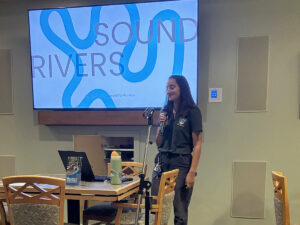
“If there is any hope to sway Rocky Mount City Council’s decision, we need more voices there,” said Pamlico-Tar Riverkeeper Katey Zimmerman. “If you share our concerns about how hyperscale data centers will impact communities and our water resources, make your voice heard at the next City Council meeting.”

Katey, along with nine other Rocky Mount residents, spoke out against a data center at the council’s May 11 meeting. During that meeting, the Council voted to annex 171 acres on Arrow and Dozier roads, but postponed a vote to rezone the land from commercial to heavy industrial to a later date.

Though yet to be confirmed by the City, the language of the rezoning proposal points to a coming data center — language regarding noise limits; prohibiting use of diesel generators and using “non-water-intensive cooling methods.”

The request to rezone the property was initially presented to the City’s planning board in April, but description of the industry behind the rezoning has remained vague.

In addition to a potential Rocky Mount data center, Edgecombe County residents are also urging county commissioners to turn down a data-center proposal for Kingsboro Business Park. Energy Storage Solutions proposal to build a $19 billion, 900-megawatt data center has met with local resistance.

If approved, both sites would rely on Rocky Mount’s utilities infrastructure.

Concerns about data centers include massive energy and water consumption, straining local grids, increasing emissions and depleting water resources, leading to community conflicts, particularly in drought areas. Often, the water used to cool systems is super-heated in the process and then cooled with gases known to contain PFAs. Whether the water will be treated to remove the PFAs — if that’s even an option — or discharged straight into the Tar River is another concern.

Katey encourages those concerned about data-center impacts to attend the June 8 meeting and speak up during the required public hearing.

“This will be the last opportunity to do so before a decision is made on the industrial rezoning, and before Rocky Mount opens up this City-owned land to a data center developer,” she said.

The meeting will be held at 7 p.m. on Monday, June 8, on the third floor of the Frederick E. Turnage Municipal Building, 331 S. Franklin St., Rocky Mount. Note: agenda items are subject to be removed or postponed at the discretion of city staff.

Like the work your Riverkeeper is doing to protect the Tar-Pamlico? We do! Donate today to support her work!

Want to speak up at the meeting, but don’t know what to say? Read Katey’s Data-Center Talking Points below!

Urge the City Council to provide transparency
Rocky Mount is requesting to rezone 171 acres of city-owned land to Heavy Industrial without disclosing what they plan to use this land for. If City Council has been having conversations with a data center developer, that information should be shared to allow for informed public input before major land use changes occur. 

The rezoning request language points to a Data Center
The language (that can be found in April 14th’s Planning Board Agenda) in the conditions for the rezoning request clearly point to a planned data center. Some of this language is listed below:

Noise
“Sound levels should not exceed sixty (60) dBA…”


Water Efficiency and Resource Protection

“The development should minimize potable water use through air-cooled, closed-loop, or other non-water-intensive cooling systems…”
“Water-intensive cooling systems shall only be permitted upon demonstration that no feasible alternative exists…”


On-Site Power Generation and Emissions
“..natural gas, renewable energy, battery storage, or other lower-emission technologies approved… Diesel-fueled generators are prohibited.”


Load Management
“The development shall implement load management strategies to reduce impacts to the electrical grid…”
“…reduce reliance on peak-period generation.”

While there are some beneficial conditions set in the rezoning language, these conditions are not nearly enough to protect communities from the impacts of data centers. 


Water Concerns from a Data Center


Hyperscale data centers use millions of gallons of clean freshwater per day to keep their equipment cool. This water, in most cases, is sourced from water treatment facilities that withdraw water from our Rivers. 

Water used by data centers is not returned in the same condition it was originally taken in. Water used for cooling must be treated to remove contaminants introduced in the cooling process. Water discharged to the water treatment systems and ultimately discharged to our Rivers is often returned more polluted with harmful contaminants.

Wastewater discharged from data centers may contain biocides, corrosion inhibitors, and heavy metals (such as zinc, copper, or lead). Although understudied, forever chemicals (PFAS) may also be a pollutant of concern. These contaminants can negatively impact our water treatment systems, increase costs of treatment, and negatively impact our surface waters upon discharge.

Rocky Mount’s waterways are already stressed. This region is currently experiencing severe drought, as cited by the Department of Environmental Quality (DEQ). Adding additional high volume water users in a time of severe drought puts additional stress on the Tar River ecosystem, risking water scarcity issues long-term. 

Impacts from development runoff and stormwater pollution cause sediment, bacteria and chemicals to enter waterways. 

To accommodate the needs of a data center, localities often have to make costly upgrades and improvements to their water infrastructure. 

The high energy and water needs of a data center often cause utility rates to increase for community members. 

How to Write a Strong Public Comment:
Be clear and direct: Start off naming the purpose of your comment. What is the issue you are speaking about? Don’t bury the lead, but get to it right away and repeat it! 
Lean on the evidence: Our comments are strongest when the evidence we present is science-backed and verifiable. This guide includes a lot of peer-reviewed science to support your claims. 
Bring in your experience: The best comments don’t just repeat talking points, but bring in personal experiences to explain why they matter. Think about why this matters to you. Do you or your loved ones have direct experience with the issues you’re discussing? Personalize your comments by bringing in the reasons why you specifically care.
State your demand at the start and end: Make sure to communicate a clear and concrete ask (adopt a moratorium on data centers in Durham!) — when you open and close your comment.

Tips for Delivering Powerful Oral Comments:
Write your comments beforehand — you don’t have to stick to every word on the script, but plan out what you are going to say.
Have a paper copy with you on the night of the hearing.
Speak slowly (slower than you think), clearly (enunciate), and calmly.
Make your most important point first — get straight to the point after your introduction and expand from there as time allows.
Stick to the allotted time limit — you will be cut off if you go over!
Assume 2 minutes since we are expecting many speakers.

Related News

Raleigh creek remains contaminated after sewage spill May 28th 2026
Rocky Mount adds data-center rezoning to June 8 agenda May 28th 2026
Sampling begins to identify septic “hot spots” May 28th 2026
Runyon Creek open house nets good stormwater strategy May 28th 2026
Sound Rivers investigates 1.1-million-gallon sewage spill May 21st 2026
Sound Rivers welcomes 2026 interns May 21st 2026