News
Riverkeepers talk sediment with DWR director
Advocacy, Neuse River Watershed, Sound Rivers, Tar-Pamlico Watershed, Water Quality
Posted on June 12th, 2025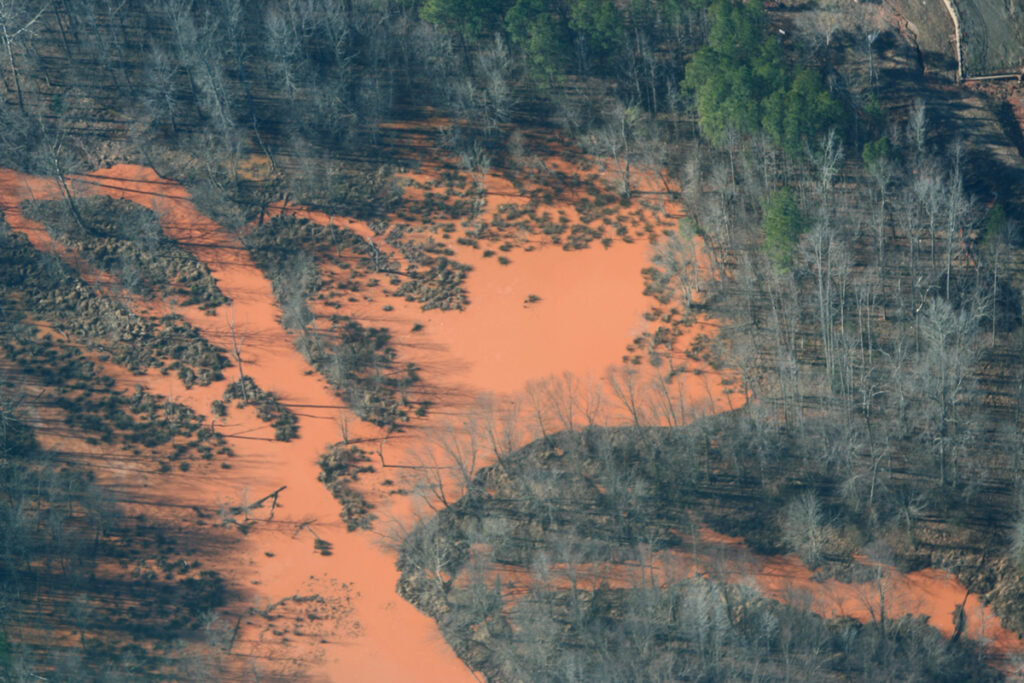
Stormwater runoff picked up sediment from a southeast Durham construction site and carried it from the site into nearby wetlands.
Neuse Riverkeeper Samantha Krop and Pamlico-Tar Riverkeeper Katey Zimmerman were in Raleigh this week to meet with North Carolina Department of Environmental Quality Division of Water Resources Director Richard Rogers.
Katey, Samantha, Emily Sutton and Kaitlyn Elliot from Haw River Assembly and Ellie Riggs and Ryan Carter from Catawba Riverkeeper Foundation met up in Raleigh to talk about sediment pollution with Rogers and other DWR and Department of Energy, Minerals and Land Resources staff. The two agencies are responsible for enforcement of sediment and erosion control regulations in the state of North Carolina.
“The purpose for us was to, on the advocacy side, to get together with the regulatory agencies to talk about this loophole we’ve been seeing around construction sediment,” Katey said.
The loophole in question is really high levels of sediment/turbidity in waterways: as long as a construction site has the required sediment and erosion control requirements, it is considered compliant—even if it’s clear that the sediment pollution is running off of the site or being released from sediment catch basins on the site.
“We first just shared some of the examples we’ve been seeing — like the ongoing sediment-pollution in Lick Creek that Sam’s been working on for three years, then we gave them the floor to give input on any solutions as to how this loophole can be addressed,” Katey said. “We ended up having really good conversations about what we thought would be good solutions.”
One potential solution could get further investigation: different sediment and erosion control requirements based on location, because not all soil is the same. For example, S&EC controls don’t prevent tiny particles of Triassic soil found in Durham from flowing through the controls; they also don’t sink and settle as heavier soils, so elude the purpose of sediment basins.
The assembled also talked about a potential grading limit: limiting how much land could be clear-cut at one time to make way for development in order to limit the amount of soil exposed, leaving sediment to be swept off site and into waterways by a hard rain.
“Our next steps are figuring out how we can move forward with the idea of limiting the number of acres that can be disturbed at a time, specifically in the Triassic Basin and around impaired waterways,” Katey said.
Like the advocacy work your Riverkeeping team is doing? We do! Support their advocacy work by donating today!
Related News

OYSTER ROAST 2026: Everything you need to know!
September 2nd 2026
Vote!
October 15th 2026
Industrial park threatens nearly 30 acres of wetlands
October 15th 2026
Riverkeeper gives recap of Neuse fish kill
October 15th 2026
NC Land and Water Fund comes through with two new grants
October 15th 2026
Staff, Cummins volunteers return for rain garden rehab
October 15th 2026
Photo of the Week: Sampling Run
October 15th 2026
Pamlico-Tar Riverkeeper visit Cypress Landing
October 15th 2026
CONSTRUCTION ALERT: A head’s up for Neuse paddlers in Wake County
October 15th 2026