News
Riverkeepers get an intro to septic systems
Education, Environmental, Neuse River Watershed, Sound Rivers, Tar-Pamlico Watershed, Water Quality
Posted on August 28th, 2025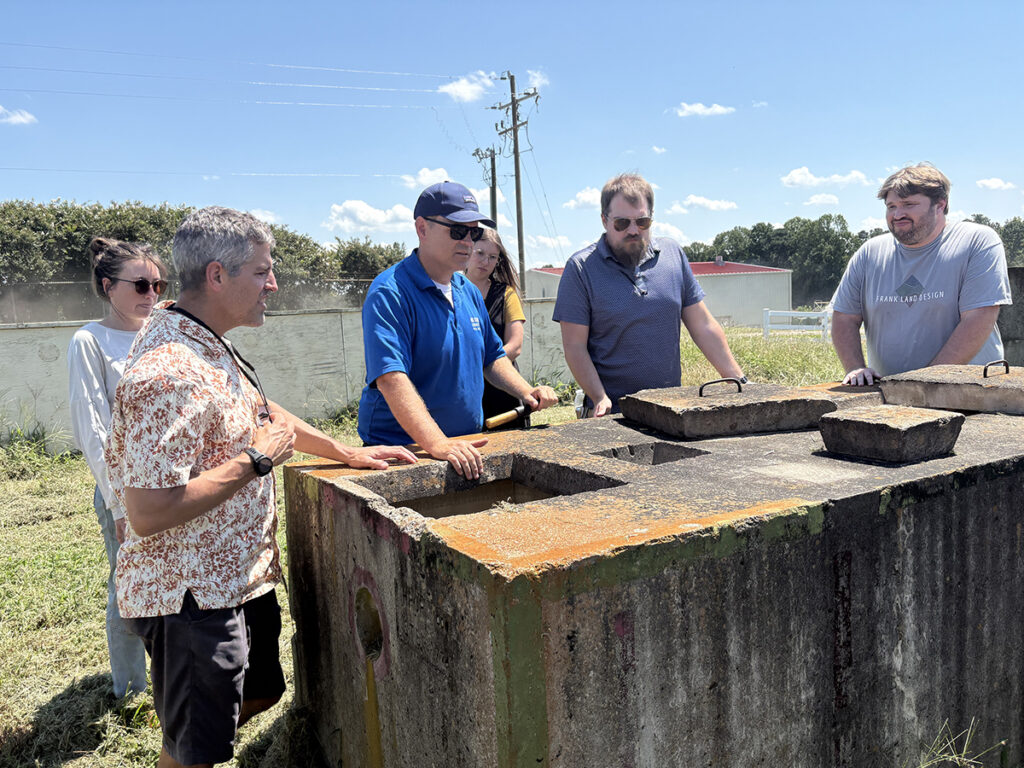
Neuse Riverkeeper Samantha Krop, along with Waterkeepers from across North Carolina, learn how septic systems work.
Neuse Riverkeeper Samantha Krop and Pamlico-Tar Riverkeeper Katey Zimmerman met up with Waterkeepers from across the state to learn more about septic systems and how they work.
“Waterkeepers Carolina gets a certain amount of funding each year for all of us to do trainings,” Katey said. “Since a lot of us are seeing a lot of issues with septic-system failures contributing to water-quality impacts, we decided to do a training on septic systems. We wanted to further understand the systems as a whole, reasons they might failing, what goes into maintenance and entities responsible for maintenance.”

Hosted by N.C. State University, 11 Waterkeepers took the six-hour course “Intro to Decentralized Wastewater” at the university’s Booth training center.
“The class itself was really awesome. Our instructor was very much like ‘What questions do you have?’ and we did have a presentation on the basics. The coolest part was at their facility, they had a bunch of septic systems of all types, so we could see septic tanks and the parts of the systems, the pipes leading to the drain fields, and see how it all functions.”
A bit of interesting information they learned was that while there are many types of septic systems, in North Carolina 95% of septic systems in use are the simplest, gravity-driven models, where no inspection is required and responsibility for ensuring it’s operating properly falls on the property owner.

“Now that we’re seeing a lot of septic failures around both watersheds, it’s good to have all that background information on how they work and be able to give homeowners more accurate information on how they should be maintained,” Katey said. “Basically, if a septic tank is over 30% full of sludge, that’s when it needs to be pumped out. Pump outs of the sludge that builds up should happen every three to five years. And if you don’t know much about your septic tank, the county health department should have permit records that you can ask for.”
Like the continuing education your Riverkeeping team is pursuing? So do we! Donate today to support their work!
Related News

OYSTER ROAST 2026: Everything you need to know!
September 2nd 2026

Vote!
October 15th 2026
Industrial park threatens nearly 30 acres of wetlands
October 15th 2026
Riverkeeper gives recap of Neuse fish kill
October 15th 2026
NC Land and Water Fund comes through with two new grants
October 15th 2026
Staff, Cummins volunteers return for rain garden rehab
October 15th 2026
Photo of the Week: Sampling Run
October 15th 2026
Pamlico-Tar Riverkeeper visit Cypress Landing
October 15th 2026
CONSTRUCTION ALERT: A head’s up for Neuse paddlers in Wake County
October 15th 2026