
News
Riverkeeper: southeast Durham watershed improvement plan lacking key data
Environmental, Neuse River Watershed, Sound Rivers, Water Quality
Posted on January 22nd, 2026
An improvement plan for a trio of watersheds in southeast Durham needs more work, according to Neuse Riverkeeper Samantha Krop.
On Tuesday night, Samantha attended the public information session for the Southeast Durham Watershed Improvement plan, part of the City of Durham’s efforts to improve the health of Durham’s creeks and comply with water-quality regulations.
The plan encompasses three watersheds: Stirrup Iron, Brier and Lick Creek.
“Basically, the City did a multi-fold watershed health assessment which includes assessment of things like stream-bank erosion, stormwater control measures that exist, assessment of water quality and kind of like a forward-thinking assessment of where projects that would be beneficial for stream health could happen. They also look at different areas of land that are in private holding, and rate them for strategic conservation,” Samantha said.
For three years, City employees have compiled data on water quality in these watersheds and spent plenty of time in the field, studying erosion, undercut banks, stormwater control measures and more.
“They walked a lot of stream miles in each of the watersheds to do their assessment, like boots on the ground, actually walking the banks,” Samantha said. “But there was a robust discussion about what the report is missing. I think that given our understanding of what is happening in the Lick Creek watershed, the report is missing some really important, key pieces.”
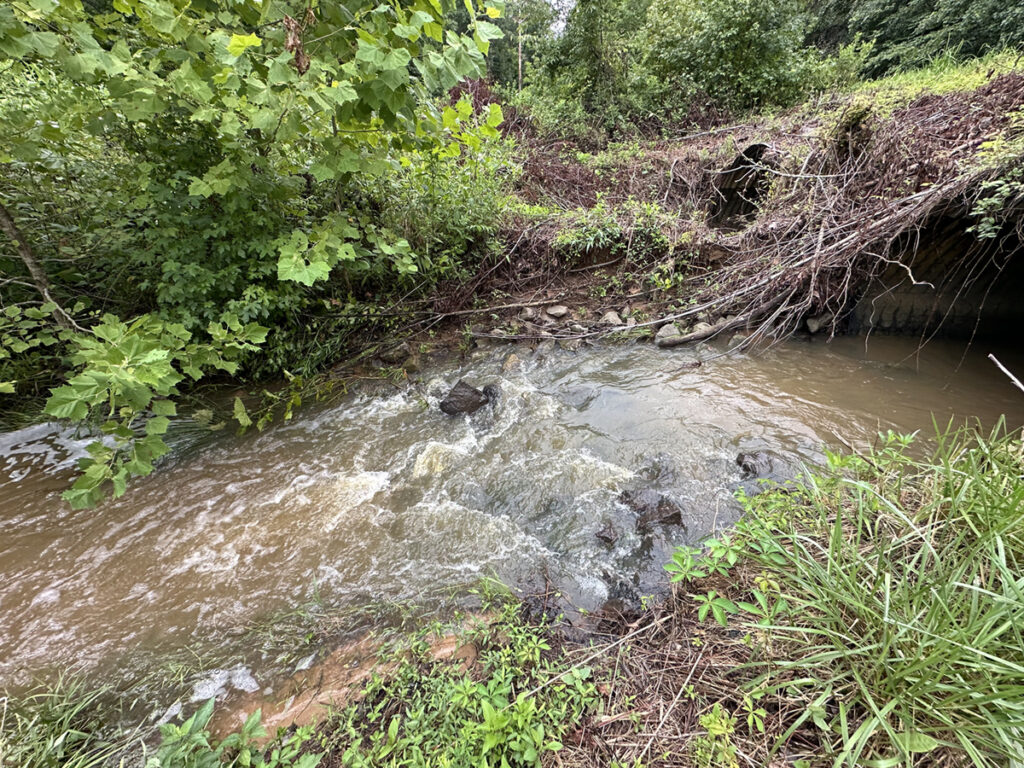
Samantha has been documenting the impacts of development in the Lick Creek watershed for nearly four years. Her findings of extreme sediment pollution in Martin Branch and Hurricane Creek, both tributaries of Lick Creek, led to the Southern Environmental Law Center filing a lawsuit on behalf of Sound Rivers in 2023. Last year, the developer, Mungo Homes, settled the lawsuit, resulted in federal fines paid, a commitment to increasing erosion and sediment controls and purchase and conservation of a 62-acre undeveloped tract in the Lick Creek watershed, now managed by Triangle Land Conservancy.
Though Samantha has seen firsthand how some streams in the Lick Creek watershed have been impacted by sediment pollution, the sampling data informing the Watershed Improvement Plan did not reflect it.
“They gave Lick Creek a B for water quality,” she said. “I learned that for the water-quality portion, they were only in two locations in Lick Creek: one of them is on Rocky Branch, which we used as a control in our sampling and the other was near Falls Lake, where the U.S. Army Corps of Engineers has land, so it’s essentially conversation land.”
Samantha said the water-quality grade in the plan did not take into account the impacted streams in the Lick Creek watershed, nor the most impacted stretches of Lick Creek itself.
“That B grade really reflects assessment done in the healthiest parts of the watershed,” she said.

Another issue brought up by community members was the lack of a historic record.
“A lot of people at the meeting commented on how much Lick Creek has changed and how much worse it is, but there’s nothing to compare that to,” Samantha said. “For example, they looked at stormwater control measures but not construction impacts. None of the local knowledge was utilized.”
According to one community member, the City needs to shift its focus in southeast Durham: “We don’t need to be talking about an improvement plan; we need to be talking about a protection plan.”
The City is asking community members/stakeholders in these southeast Durham watersheds to join an advisory board. More information about the advisory board and how to join can be found here.
Like the work your Riverkeeper is doing to protect Lick Creek, a Falls Lake/Neuse River tributary? We do! Donate today to support her work!
Related News

Momentum growing for data center resistance
March 5th 2026
New sediment issue reported, this time on Little Lick Creek
March 5th 2026
Sediment pollution spotted on Tar River tributary
March 5th 2026

Riverkeeper shares Sound Rivers’ work at annual science symposium
March 5th 2026
Durham’s planning process comes to a screeching halt
February 26th 2026
Riverkeeper taps into emerging issues
February 26th 2026
Riverkeeper: rezoning for more housing in floodplain a bad idea
February 26th 2026
Windy, cold field day for sample-collecting specialist
February 26th 2026
