News
Riverkeeper: extremely elevated levels of E. Coli found in Lenoir Co. stream
Posted on May 13th, 2021
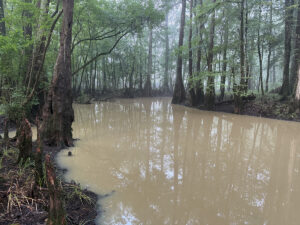
Lower Neuse Riverkeeper Katy Hunt found elevated levels of E. coli in a stream near Deep Run, in Lenoir County, this week, a fact that may be attributable to a hog operation upstream. The site, located on Sandy Foundation Road near two industrial hog operations, is one the Riverkeeper monitors regularly. On Tuesday, there was a marked change in the appearance of the sampled water, as well as a strong odor in the area.
“I got out of the truck, and the smell of hog waste hit me immediately,” Hunt said. “There was a brown, oily sheen on the water, and it left a brownish-orange residue in my sampling bottle.”
Hunt said she notified the North Carolina Division of Water Resources about what she’d found and was told an investigator would visit the site.
On Wednesday, Hunt’s preliminary testing of the water sample for the bacteria E. coli turned up elevated results — much more elevated than state requirements for recreational water quality. The state standard for calls for less than 235 parts per million of E. coli in a given sample; Hunt’s results measured an MPN (most probable number) of more than 2,400 ppm.
Hunt confirmed the Division of Water Resources has launched an investigation. The agency releases no information to the public unless (and until) a Notice of Violation is issued by the state against those responsible for pollution.
This post will be updated as more information becomes available.

Related News

OYSTER ROAST 2026: Everything you need to know!
September 2nd 2026

Riverkeeper encounters drought effect on paddling trip
November 12th 2026
Kinston creek litter-free thanks to volunteers
November 12th 2026
Water Watch goes next level
November 12th 2026
No new action taken on Brices Creek sediment pollution
November 12th 2026
Litter-Free Rivers update: Jack's Creek, Washington
November 12th 2026

Riverkeeper, councilman urge residents to speak up for Rocky Mount’s water
November 5th 2026
Slocum sampling in the home stretch
November 5th 2026
Blounts Creek baseline data collection continues
November 5th 2026