
News
Riverkeeper calls out loophole in Durham environmental protections
Environmental, Neuse River Watershed, Water Quality
Posted on January 29th, 2026
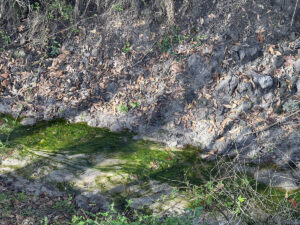
Part of the developer's application to impact 2.65 acres of buffers in the Howard's Place development.
A process allowing developers to change approved development plans is under scrutiny in Durham.
Neuse Riverkeeper Samantha Krop is speaking out about what she calls a loophole in which developers can work around environmental protections with No Practical Alternative Applications.
“Essentially, it is a process where developers can apply to impact streams, vegetative, Riparian buffers and other natural resources that would otherwise not be allowed to be impacted according to Durham statute,” she said. “The problem is — and it’s a major problem — this NPAA process happens behind closed doors, without any public notification and does not require approval by Durham’s elected officials.”
Samantha was tipped off to the use of NPAAs by a community member who discovered the process through a public records request from the city. Samantha’s own public records request revealed a widely used, but little known, workaround for developers.
“I learned that city staff approved 20 NPAAs, which resulted in over 195,000 square feet of stream and buffer impacts, in 2025 alone,” Samantha said. “The only reason I found about that is because of my public records request. Council doesn’t even know that these are necessarily happening.”
Samantha also discovered the developer of 86-acre tract of land in the Lick Creek watershed, rezoned by the city last year, currently has an NPAA under review. She and many others spoke out against the rezoning of Howard’s Place, citing the land’s listing on the state’s Natural Heritage Registry and potential impacts to streams in a watershed already overburdened with development and sediment pollution.
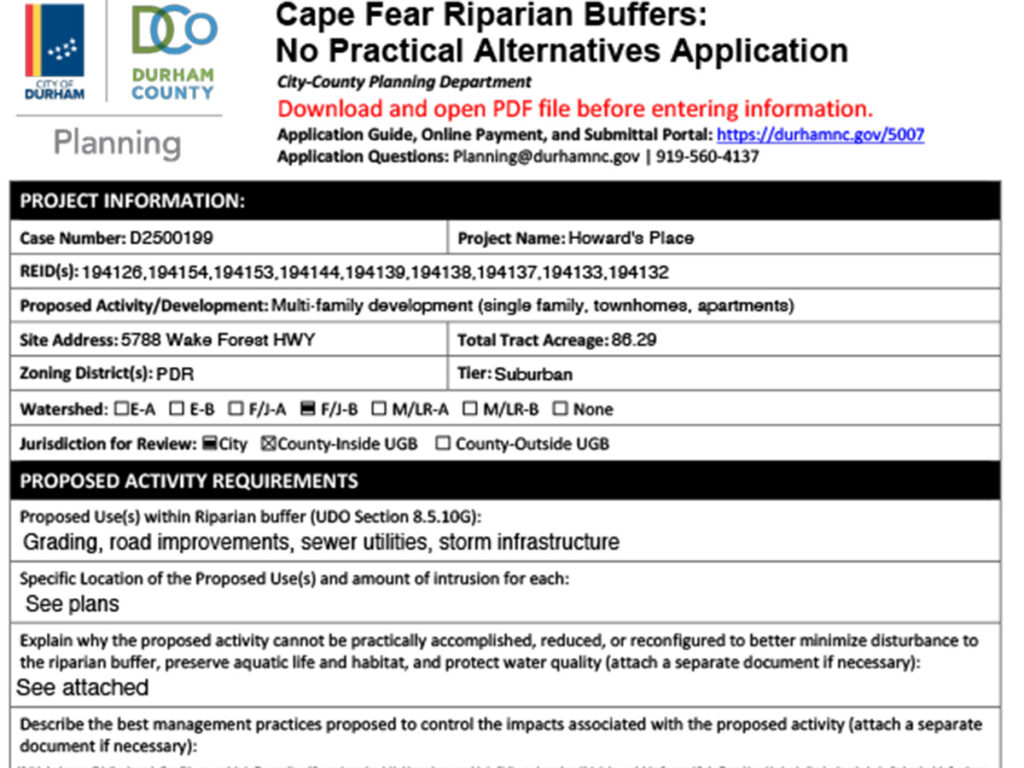
“The developer submitted a request for almost 115,500 square feet of buffer disturbance, which equals about 2.65 acres. That was alarming,” Samantha said. “What really got me upset about this, is that there was a lot of conversation during the rezoning of Howard’s Place. The developer said explicitly in the hearing that they were required to protect water resources. So, it got approved, and months and months later, they came back and asked for an NPAA that would actually disturb those water resources. Developers can get on the dias and assure city council members they’ll follow the rules, and basically, the Council goes ‘OK, well, we don’t have to worry about it,’ then turn around and request all these impacts later. And no one knows about it except the city’s planning department. This is a particularly egregious example, but the city has not approved the Howard’s Place NPAA yet — it’s still under review.”
The Durham Planning Department will make a presentation on the NPAA process at the Council’s Feb. 5 work session.*
“We’re asking for more public transparency in the process, for the city to make a public notification system so that people who want to know what NPAAs have been submitted for which properties can find out easily, without making a public records request,” she said.
Samantha is encouraging Durham residents to watch or attend the Durham City Council work session on Feb. 5 at 1 p.m. in the Committee Room at 101 City Hall Plaza, and comment on the NPAA process. Find out more here.
Like the work your Riverkeeper is doing to protect your waterways? We love it! Donate today to support her work!
*This article previously stated that Durham Council had requested explanation of the NPAA process, however Durham Planning Department staff proactively suggested they give a presentation at the work session. We’re glad to set the record straight.
Related News
Litter-Free Rivers expands to Smithfield with newest trash trap
March 19th 2026

Riverkeeper does flyover of Hyde Co. CAFO hit by avian flu
March 19th 2026

Volunteer coordinator welcomes New Bern newcomers
March 19th 2026
Waterkeepers Carolina Spring Conference
March 19th 2026

Trash trap cleanout an alternative spring break choice
March 19th 2026

Riverkeeper attends first Edgecombe Co. data-center advisory group meeting
March 19th 2026
ENC facility hit with avian flu
March 12th 2026
Latest results show ongoing pollution of Nahunta Swamp
March 12th 2026
