News
Program director talks resiliency in Bath
Environmental, Flooding, Sound Rivers, Tar-Pamlico Watershed, Wetlands
Posted on January 29th, 2026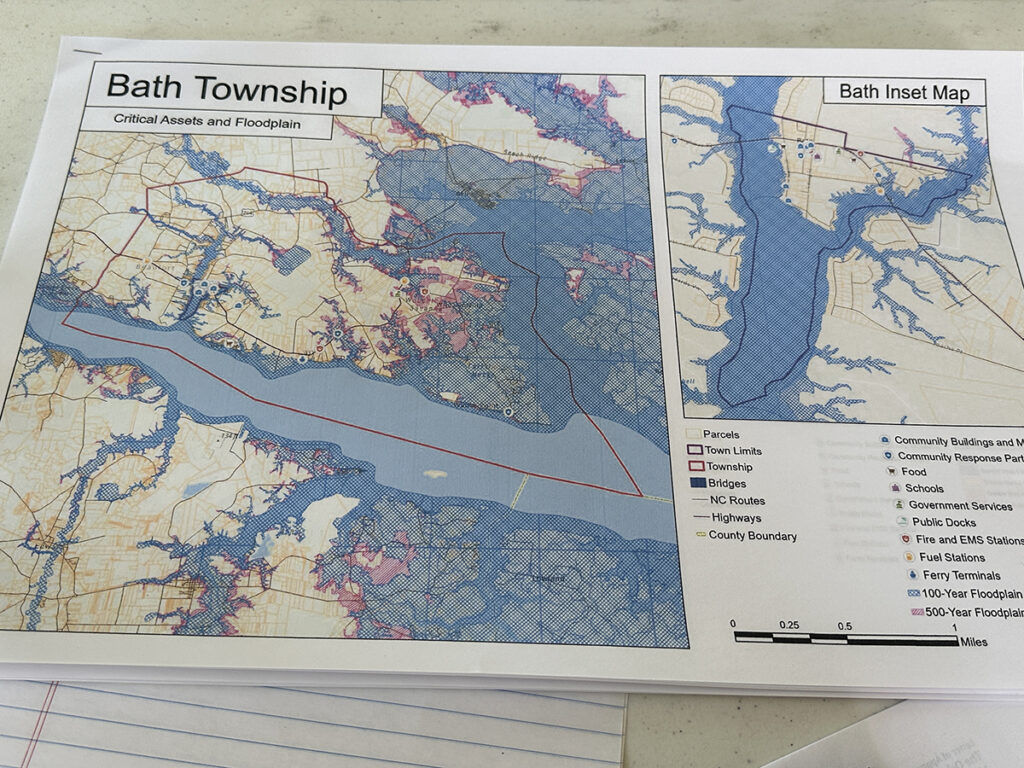
Bath Township, outlined in red, includes many low-lying areas along the Pamlico and Pungo rivers.
A resiliency plan is in the works for Bath Township and Program Director Clay Barber is weighing in.
Clay joined the Mid-East Commission’s Jamie Heath and other stakeholders in Bath this week, for a day of discussion about the area’s critical assets and to determine their vulnerability when faced with hurricanes and potential sea-level rise. The resiliency plan is funded by a state Resilient Coastal Communities Program grant.
“They’re really considering a lot of factors, like infrastructure in roads, bridges, buildings and emergency response, but also wetlands, streams and natural areas,” Clay said. “It’s kind of like the watershed restoration plans we’ve done, but community-wide.”
The goal is to amass data now to make recommendations for the future. The next meeting, he said, will focus on specific projects, and if those projects line up with the greatest need.

“It’s like our Campus Stormwater assessments: our engineers determine the Top 3 projects, then we go to the school and listen to which one school officials say we need to do because the impact is the greatest,” Clay said.
One unexpected takeaway from Wednesday’s meeting was the general consensus that wetlands are a critical asset for the region.
“Part of the vulnerability assessment included a monetary value on the critical assets, and the monetary value of wetlands was in the billions, second only to roads,” Clay said. “Everyone agreed that wetlands are really important to Bath, and they’re relevant today more than ever because this area is a draw for developers coming in, looking at land that backs up onto streams and creeks. Wetlands and streams — we’ve been losing those like a cancer over a long period of time and those take much longer to replace.”
Wetlands are critical to flood mitigation, especially for low-lying areas. To learn more about the importance of wetlands, listen to Sound Rivers’ podcast, “What About Wetlands?”
If you like the work Sound Rivers’ Program staff is doing to plan for future flooding, consider a donation to today to support their work!
Related News
Flyover reveals Brices Creek sediment pollution sources
September 17th 2026

Low oxygen levels cause of New Bern fish kills
September 17th 2026
Inaugural Spruce up the Neuse a huge success
September 17th 2026
Boat day doubles as algal bloom surveillance
September 17th 2026
Controversial dock expansion prompts Riverkeeper response
September 10th 2026
Riverkeeping team investigates Brices Creek pollution
September 10th 2026

Parts of upper Tar watershed still in exceptional drought
September 10th 2026
Court affirms State must protect resources
September 10th 2026