
News
New, innovative stormwater project doing its job
Flooding, Neuse River Watershed, Stormwater Restoration Projects, Water Quality
Posted on January 29th, 2026
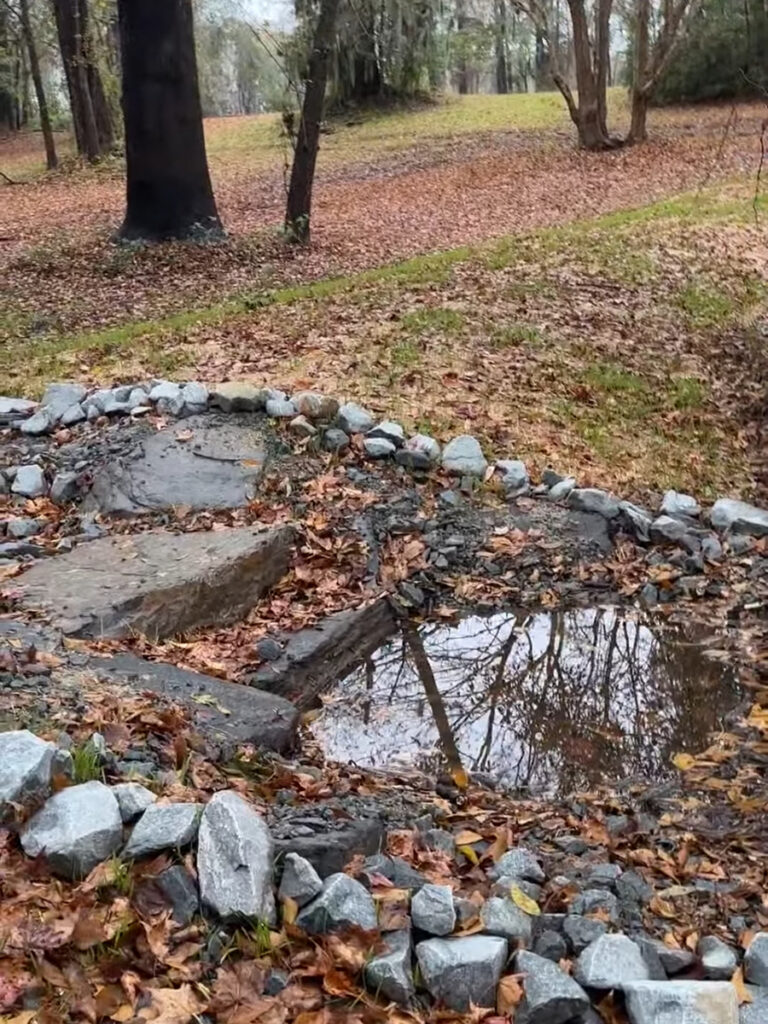
Program Director Clay Barber inspects the newly installed berm, part of an expansive regenerative stormwater conveyance system at West Craven Middle School.
Sound Rivers Program Director Clay Barber was in Craven County last week, checking in on West Craven Middle School’s newly installed regenerative stormwater conveyance system.
And all systems are go, according to Clay.
“It looks great, the sandy seepage berms look like a chia pet,” Clay laughed. “There’s super-long, fluffy grass, which is exactly what we want. We’ll let that vegetation grow and get settled in as much as possible before the springtime, when we’ll be back for some more planting.”

The project wrapped up in late 2025, and looks a bit different that the average RSC. Regenerative stormwater conveyance systems typically funnel stormwater into a series of pools down a slope, making the water to slow down and get absorbed rather than eroding the slope. The WCMS project is different in that in this sparsely wooded area, there is little slope, but stormwater from the school’s athletic fields flows arbitrarily through it, causing random erosion. This RSC adds height to the landscape in the form of berms to funnel stormwater into less structured pools.
“The system is very large, and the majority of stormwater from the average storm event winds up at the end of the system, but it kind of comes in from the sides to the end, to a little wetland there,” Clay said. “From there, it kind of backflows into the project, backs up into our cell (pool) then settles in. At the end of the system, water is being treated in a manner I am pleasantly surprised with. We typically build things that are undersized, but this thing is massive. You would need to see torrential, hurricane-like rain to actually see this entire system flowing with water.”

The next part of the project is to collect the data on how well it’s working, courtesy of a Sound Rivers’ partnership with Dr. Charlie Humphrey of East Carolina University’s Health and Human Services. Prior to the RSC’s construction, Humphrey’s team collected erosion data in the area.
“Once all the vegetation is declared fully established, ECU will start their post-construction soil erosion study. Then we’ll be able to tell if there’s less erosion,” Clay said.
Like the work Clay’s doing with Sound Rivers’ Campus Stormwater Program? We do! Donate today to support innovative stormwater projects like this!
Related News
Program director scouts potential projects at Rocky Mount High School
February 5th 2026

Strategizing the star of Kingsboro data center meeting
February 5th 2026
Snowmageddon: Oriental
February 5th 2026
Cleanup community honors prolific litter-getter
February 5th 2026

Ice an unexpected litter-free helper
February 5th 2026

Riverkeeper represents Sound Rivers at film festival
February 5th 2026

Wayne County biogas facility pollution nets NOV, again
January 29th 2026

One man, 75 tons of trash
January 29th 2026
