News
Neuse fish kill expected to extend beyond holiday weekend
Algal Blooms, Fish Kills, Neuse River Watershed, Sound Rivers, Water Quality
Posted on July 3rd, 2025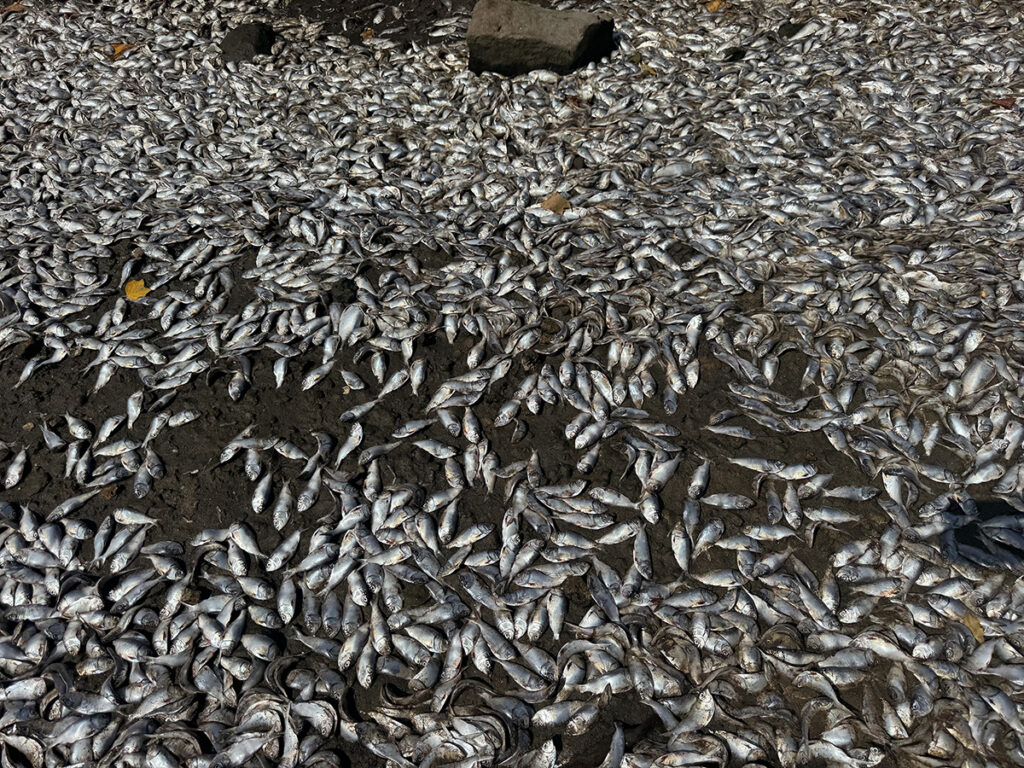
Thousands of dead juvenile menhaden on Flanners Beach, located in the Neuse River Recreation Area of Croatan National Forest.
A fish kill spotted early this week at Flanners Beach on the lower Neuse will likely continue.
On Tuesday, Sound Rivers received a report, and photos, of thousands of dead juvenile menhaden on the beach, located in the Neuse River Recreation area of Croatan National Forest.
Water Quality Specialist Taylor Register made her way to the site that day.
“My readings showed extremely high dissolved oxygen levels and water temperature, and well as elevated pH,” Taylor said. “With dissolved oxygen being so high in the middle of the day, that’s a pretty good indicator of algal-bloom conditions, with the fish kill likely related to dramatic dissolved oxygen drops at nighttime.”
The Riverkeeping team reported the kill to North Carolina Department of Environmental Quality — staff at the Division of Water Resources had also noted anoxic conditions at the bottom of the river, farther offshore from where the kill occurred, according to Taylor.
“We’ve had a lot of southwest winds recently that have been pushing low-oxygen water directly towards the Flanners Beach section of the Neuse, which is why the fish kills have only been happening in this area so far,” she said. “Based on the data I collected yesterday, DEQ said this indicates a heavy algal bloom that may continue to cause more localized kills.”

Neuse Riverkeeper Samantha Krop said that while fish kills can happen pretty regularly on the Neuse, no one should normalize them.
“This is a sign of a river in distress,” Samantha said. “Excessive heat, excessive rainfall washing more nutrients into the waterways — the root cause of both is global warming and the climate change we’re experiencing. While many are doing good things to reduce nutrient pollution, fish kills are another sign of how much more we need to do.”
Sound Rivers recommends avoiding contact with the water where a fish kill or algal bloom is occurring. Signs of an algal bloom include smelly or discolored water.
Samantha said fish kills like the one at Flanners Beach, and the ones that could potentially happen over the next week, should serve as a wake-up call.
“Fish kills aren’t natural, and they aren’t inevitable,” she said. “When you see a fish kill, it’s a call to action to do more to protect our waterways.”
Like the work your Riverkeeping team is doing? We certainly do! Donate today to support their work!
Related News

2026 Oyster Roast Ticket Sales
September 2nd 2026
OYSTER ROAST 2026: Everything you need to know!
September 2nd 2026
Riverkeeper, specialist investigate Bridgeton fish kill
September 24th 2026
Cummins, Sound Rivers partner in schools’ cleanup
September 24th 2026
Scouting group goes on environmental adventure
September 24th 2026
Flyover reveals Brices Creek sediment pollution sources
September 17th 2026
Low oxygen levels cause of New Bern fish kills
September 17th 2026
Inaugural Spruce up the Neuse a huge success
September 17th 2026
Boat day doubles as algal bloom surveillance
September 17th 2026
Controversial dock expansion prompts Riverkeeper response
September 10th 2026