News
Durham’s planning process comes to a screeching halt
Posted on February 26th, 2026
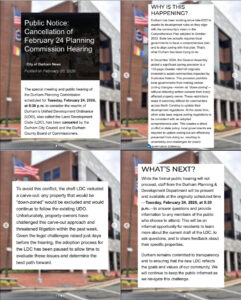
The process of rewriting Durham’s Unified Development Ordinance came to an abrupt halt last week due to a bit of legislation tacked onto a state bill in 2024.
“In December of 2024 — which is a while ago now — the General Assembly added a significant zoning provision to the Hurricane Helene relief bill. It was a typical rider in that it had nothing to do with Hurricane Helene,” said Neuse Riverkeeper Samantha Krop.
The zoning provision in question prohibits local government from making specific zoning changes known as “downzoning,” a process in which a property can be rezoned from a high-intensity use (e.g., commercial or high-density residential) to a less intense, more restrictive use (e.g., single-family residential or open space) — prohibits them unless written consent is given by all property owners in the area.
This means an area previously zoned for industrial or commercial use can’t be rezoned to single-family homes or conservation management.
Though the city’s planning department was moving ahead with its UDO employing carve-outs — meaning property owners concerned about proposed zoning changes would be exempt — it was one of those property owners threatening to sue the city that bought the UDO process to a standstill just days before a public meeting on its latest draft was to be held.
“It’s on pause, indefinitely, with no timeline to move forward,” Samantha said. “All those resources, all the hours spent by city staff, residents making comments and compiling technical comments, no one is able to move forward with anything. While we felt that the UDO draft was far from perfect, we certainly want our local governments to have the ability to update their land-use plans. That’s a really critical power. Without it, our local governments’ hands are tied in what they’re able to do. Their options are severely limited, from how to protect water quality to how to address climate impacts and respond to community needs in changing times — that becomes really challenging if you can’t change zoning code.”
For the past two years, Samantha has been an active participant in Durham’s UDO process, which brings the city’s land-use laws into alignment with its 2023 Comprehensive Plan, in itself, a comprehensive document envisioning Durham’s future growth. In that time, she attended several community open houses, met with City of Durham planning staff, had countless email exchanges, made line-by-line comments on previous UDO drafts, crafted Action Alerts and met with community members.
“I don’t how to quantify the amount of time I, and so many other people, have put into the process of planning for a future Durham,” Samantha said.
It’s the not the first time a city’s land-use process has been waylaid by the Hurricane Helene legislation: New Bern’s land use update was paused last year for the same reason.
Samantha said the result is local governments are prevented from doing the job they are required to do: create comprehensive plans and associated UDOs to provide the policy code.
“This makes it impossible for local government to change their land uses,” she said. “It basically shackles them — how is the city supposed to do their job of ensuring that zoning codes are seen through the stated vision of city leaders and the community?”
Like how your Riverkeeper is advocating for your communities? We do! Donate today to support her work!
Related News
Durham’s planning process comes to a screeching halt
February 26th 2026
Riverkeeper taps into emerging issues
February 26th 2026
Riverkeeper: rezoning for more housing in floodplain a bad idea
February 26th 2026

Windy, cold field day for sample-collecting specialist
February 26th 2026

Sound Rivers responds to EPA killing landmark climate change finding
February 19th 2026
Riverkeeper talks data centers with Edgecombe County commissioners
February 19th 2026
Water Watch hits milestone
February 19th 2026
Trash trap sign educates Wetland Center visitors
February 19th 2026