
News
Blounts Creek permit issued, public comment sought
Environmental, Sound Rivers, Tar-Pamlico Watershed, Water Quality
Posted on October 2nd, 2025
A revised permit that would regulate a mining company’s wastewater discharge into the headwaters of Blounts Creek is now open for public comment.
SEE PUBLIC COMMENT DETAILS AND SUGGESTIONS BELOW.
“It’s not as bad as it could be,” said Pamlico-Tar Riverkeeper Katey Zimmerman. “We’re glad to see that the North Carolina Department of Environmental Quality is exercising their authority to some extent after the U.S. Supreme Court decision that caused NCDEQ to rescind the permit issued in February.”
However, she said, the permit could use some additional language to protect the Pamlico River tributary in Beaufort County. Read previous coverage of the 14-year-long effort to save Blounts Creek or listen to Sound Rivers’ podcast, “The Story of Blounts Creek,” here.
One issue Katey sees as problematic is the revised permit lacks monitoring requirements that accurately show how discharge from Martin Marietta Materials’ 649-acre limestone mine is impacting the creek.
“DEQ must clearly lay out their enforcement actions attached to those monitoring requirements in the permit,” Katey said. “The permit needs to state what constitutes a violation; what exactly are the ‘levels of concern’ they refer to in which the permit needs to be reopened and reevaluated? There needs to be accountability when we see impacts to the creek. They also need to establish baseline conditions for benthic macroinvertebrates, which is something we’ve been asking for that hasn’t been established yet, but will play a huge part in establishing those levels of concern.”
Benthic macroinvertebrates are, essentially, aquatic bugs. They serve as excellent bioindicators of water quality because their presence and abundance are tied to specific water conditions.
Though the revised permit requires an assessment of biological integrity once every two years through sampling for benthos (the first sampling will occur early in February or March of 2026, after the discharge begins), the state has not studied what aquatic organisms already exist in Blounts Creek and in what numbers.
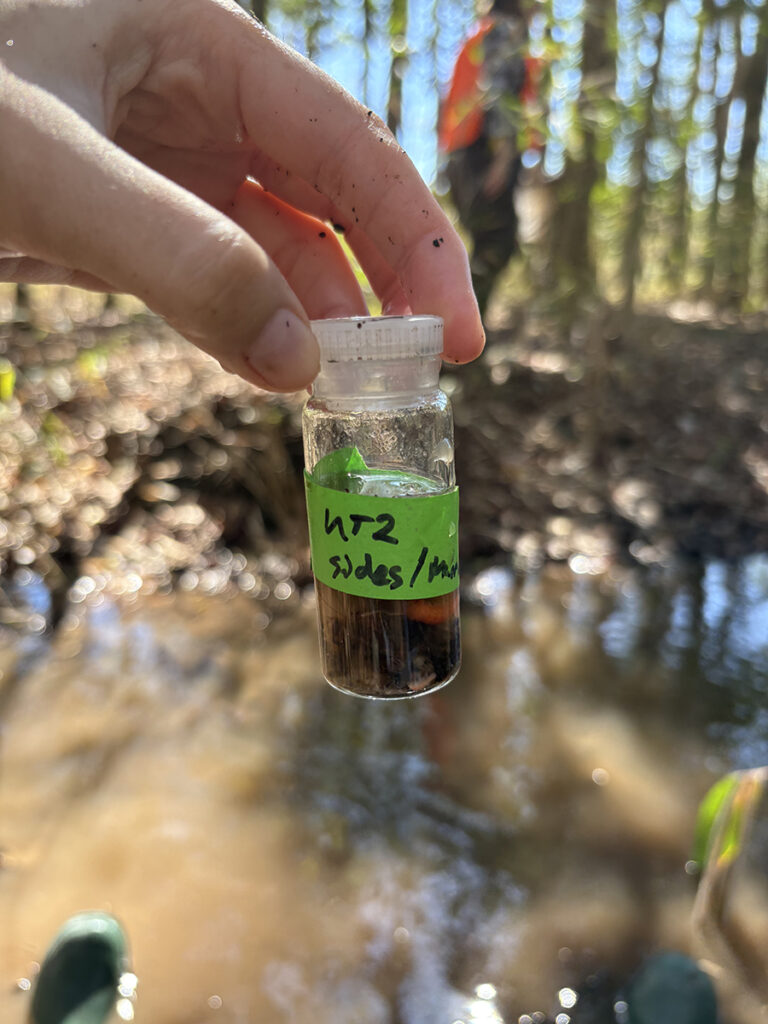
A second issue is the locations selected to monitor turbidity, pH, salinity and temperature when mining production begins and up to 12 million gallons per day of fresh water used in the mining process is discharged into the headwaters of brackish Blounts Creek.
“The upstream sampling site is located a mile upstream from Outfall 1, and we don’t know if that site is too far away,” Katey said. “We’d like them to add another sampling site closer to the outfalls to factor in stormwater runoff from the mine site.”
Another sampling site is located upstream of the convergence of the two Blounts Creek headwater tributaries to be used to discharge the wastewater, but downstream of an unnamed tributary that could affect monitoring results.
“What we’d like is for DEQ to consider adding another monitoring location to rule out impacts from this incoming tributary before the convergence,” Katey said.
Blounts Creek is known for its recreational fishing and is designated by the state as a nursery for saltwater species. Large volumes of groundwater discharged into Blounts Creek could significantly raise the pH of the stream system, a change in water chemistry that would also change which aquatic species could survive in those waters.
Vanceboro Quarry Revised Permit public comment information
Comments are due by Oct. 29.
Email comments to: publiccommentsDWR@deq.nc.gov
Send written comments to NCDEQ/DWR, NPDES Permitting Branch, 1617 Mail Service Center, Raleigh, NC 27699-1617
Suggested Talking Points
- DEQ must ensure that the monitoring and reporting conditions in the permit will accurately reflect all impacts of the mine’s 12MGD discharge to Blounts Creek
- Reconsider instream monitoring locations
- The upstream sampling location is over a mile upstream of Outfall 1 – consider adding another upstream sampling location for turbidity, pH, salinity and temperature closer to the outfall locations.
- An unnamed tributary flows into Blounts Creek from the south about ⅓ mile before the convergence of the two headwater tributaries – consider adding another monitoring location to rule out impacts from this incoming tributary before the convergence.
- Reconsider instream monitoring locations
- DEQ must ensure that these permit conditions are enforceable by providing clear consequent enforcement actions should turbidity, erosion, or benthic population impacts be seen.
- Enforcement actions are not laid out in the draft permit. What action will be taken if visual observations of erosion at the outfalls are seen, if turbidity, pH, and salinity data shows signs of impact to the Creek, or if benthic surveys show significant decline in populations and diversity?
- DEQ must set an example for how the San Francisco v EPA Supreme Court decision is interpreted in ALL subsequent NPDES permits across the State by ensuring that the permit conditions are strong and effective enough to ensure compliance with water quality standards instream.
More information about the permit can be found on the NCDEQ website.
Like the work your Pamlico-Tar Riverkeeper is doing to protect Blounts Creek? So do we! Donate today to help save Blounts Creek!

Related News
Walnut Creek trash trap install ‘a breeze’
January 22nd 2026

Riverkeeper: southeast Durham watershed improvement plan lacking key data
January 22nd 2026
Specialist kicks off grant field work with Slocum Creek sampling
January 22nd 2026

Data center subject of Riverkeeper, county manager meeting
January 15th 2026

New tool determines best projects to minimize flood risk
January 15th 2026
Sound Rivers set for newest trash trap install
January 15th 2026
2nd trash trap gets chainsaw treatment
January 15th 2026

Great Blue Heron award recipients
January 15th 2026
