News
Nash cistern project gets final piece for stormwater control status
Environmental, Sound Rivers, Stormwater, Stormwater Issues, Stormwater Restoration Projects, Stormwater Runoff
Posted on September 23rd, 2021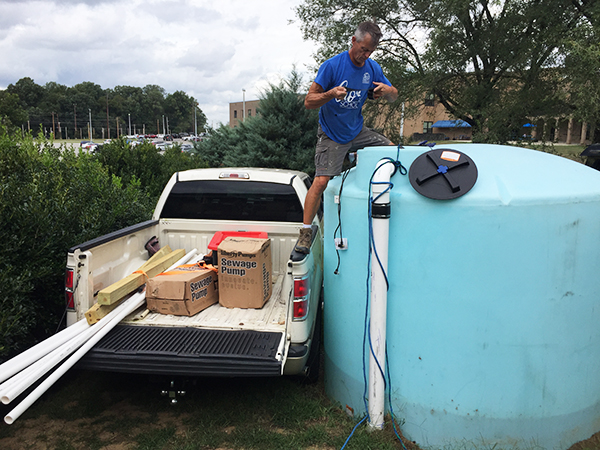
Environmental Projects Coordinator Clay Barber was on scene at Nash Community College this week, finishing up a stormwater management project with the invaluable assistance of Mitch Woodward, N.C. Cooperative Extension area specialized agent for watersheds and water quality.
The project — one of four cisterns installed on school campuses through a state Environmental Enhancement Grant — got its final piece on Wednesday: a small PVC fixture that turned a 2,500-gallon holding tank that collects rooftop rainwater into a stormwater control measure. The piece is Woodward’s original design.
“It’s a ball valve, with just a little lever, and there’s a very tiny hole at the end of that fixture. When the tank is full, more often in the winter, you open it up and it drains the tank over three days. The drip is so small, the ground is able to absorb it,” Barber said.
That means the water collected from rooftops will be naturally treated.
“This water typically contains sediment from roof tiles and whatever winds up or decomposes in the gutters — that’s what we’re removing from the water. It will infiltrate into the soil before it hits any waterway, and it will recharge the nearest aquifer,” Barber said.
The water collected in the tank will also go to good use in the growing months: Nash Community College is a certified USA tree campus and a bee campus, which requires specific plants and trees that need protection from drought. The water collected in the cistern is transferred into a water wagon that travels around campus, keeping trees and plants well-watered.
With the last step of NCC’s cistern project complete, Barber will be moving on to other campuses and upcoming projects, which include a few rain gardens.
Related News

OYSTER ROAST 2026: Everything you need to know!
September 2nd 2026

Annual Auction goes live Oct. 30!
October 22nd 2026
Sound Rivers assists in hosting first-of-its-kind Water Summit
October 22nd 2026

Riverkeeper weighs in on Raleigh land-use planning
October 22nd 2026
Water Watch, Fall 2026 quarterly meeting
October 22nd 2026
Blounts Creek Update
October 22nd 2026

Vote!
October 15th 2026
Industrial park threatens nearly 30 acres of wetlands
October 15th 2026
Riverkeeper gives recap of Neuse fish kill
October 15th 2026